A 1944 Plan in 2026 Reality: Action Alert on the Tri-Forest Sustain Yield Management Plan
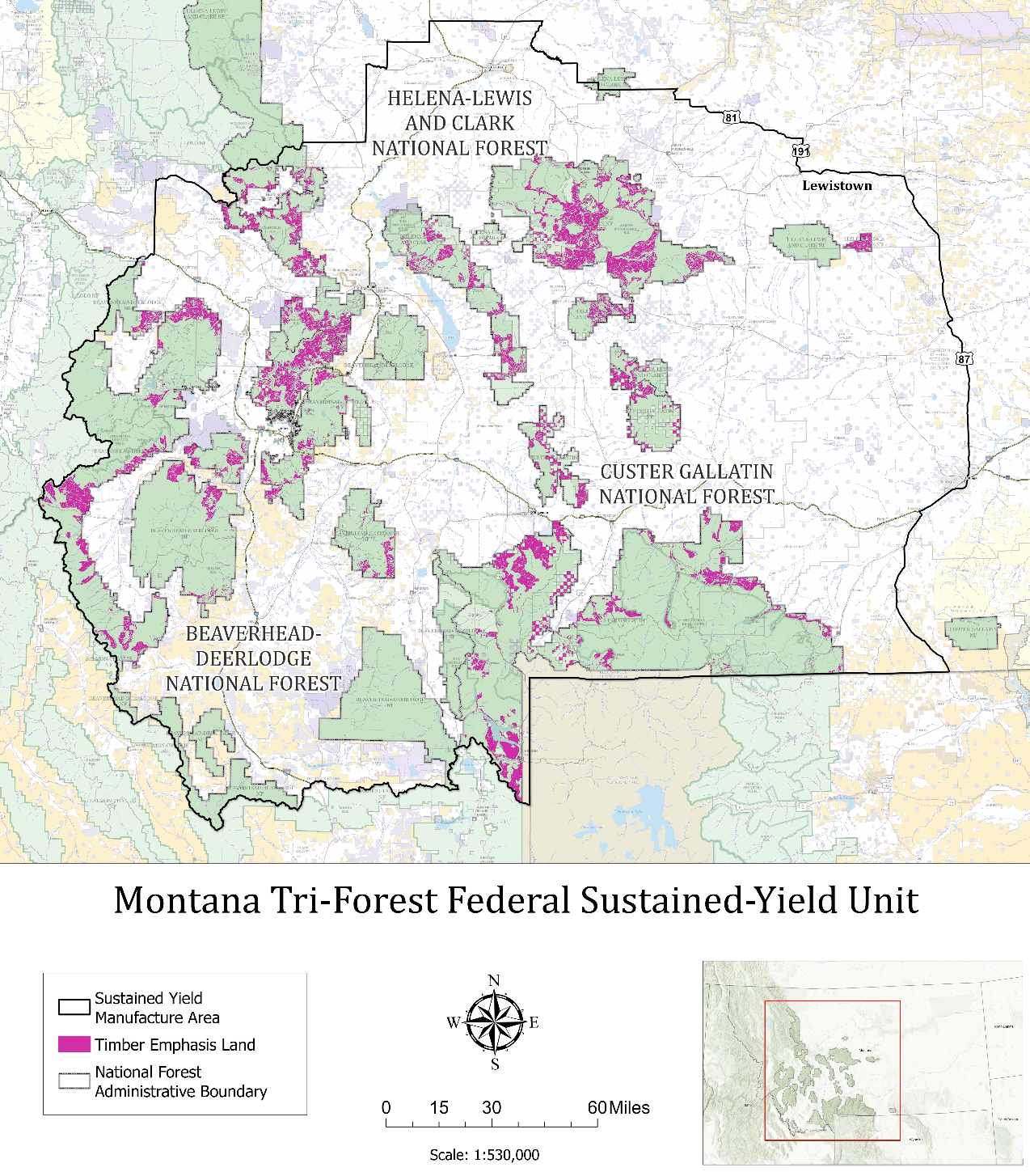
On March 2, 2026, the Forest Service released a Draft Management Plan establishing the Montana Tri-Forest Federal Sustained-Yield Unit (SYU) directing logging to occur on more than 925,000 acres across the Beaverhead-Deerlodge, Custer Gallatin, and Helena-Lewis and Clark National Forests. Under the 1944 Act, a Sustained-Yield Unit (SYU) is a commercial mandate designed to ensure a 'continuous and ample supply' of timber to specific mills; it treats the forest as an industrial warehouse with a fixed delivery quota. It is important to note, the scientific principle of sustained yield is a biological limit; it dictates that harvest levels must never exceed what the forest is actually growing, something NOT mentioned in the Tri-Forest Federal Sustained-Yield Unit proposal at all.
This administrative strategy is a significant departure from modern forest management: it utilizes the 1944 statute that hasn’t been applied to a new unit since the 1950’s; there’s never been one this large in size; and has not been one proven to achieve the goals it promises.
The Custer Gallatin National Forest (CGNF) accounts for 2,445,371 acres of the proposed 8.3-million-acre Management Unit. Within our local forest, the agency has designated 327,914 acres as ‘suitable timber lands’—the highest percentage of any forest in the Unit (13.4%). This represents a significant shift in management priority for the CGNF, which is the most-visited National Forest in the region with over 3 million annual visitors.
Despite the scale of this proposal and historical failures, the current public comment process is remarkably restrictive. The Forest Service is offering only a single in-person hearing, held in Helena on April 1st, with no local sessions provided for the communities in Bozeman, Livingston, or Big Timber that are most directly impacted. Public testimony is limited to 2-mins, it is not guaranteed, and requests must be submitted by March 31st. The 10-year management framework is being fast-tracked with a short window for written comments due April 10th.
To understand the risk the Tri-Forest (SYU) poses, we must look at the historical failures of this model, the current federal mandates driving it, and the long-term ecological and economic impact on our local landscapes.
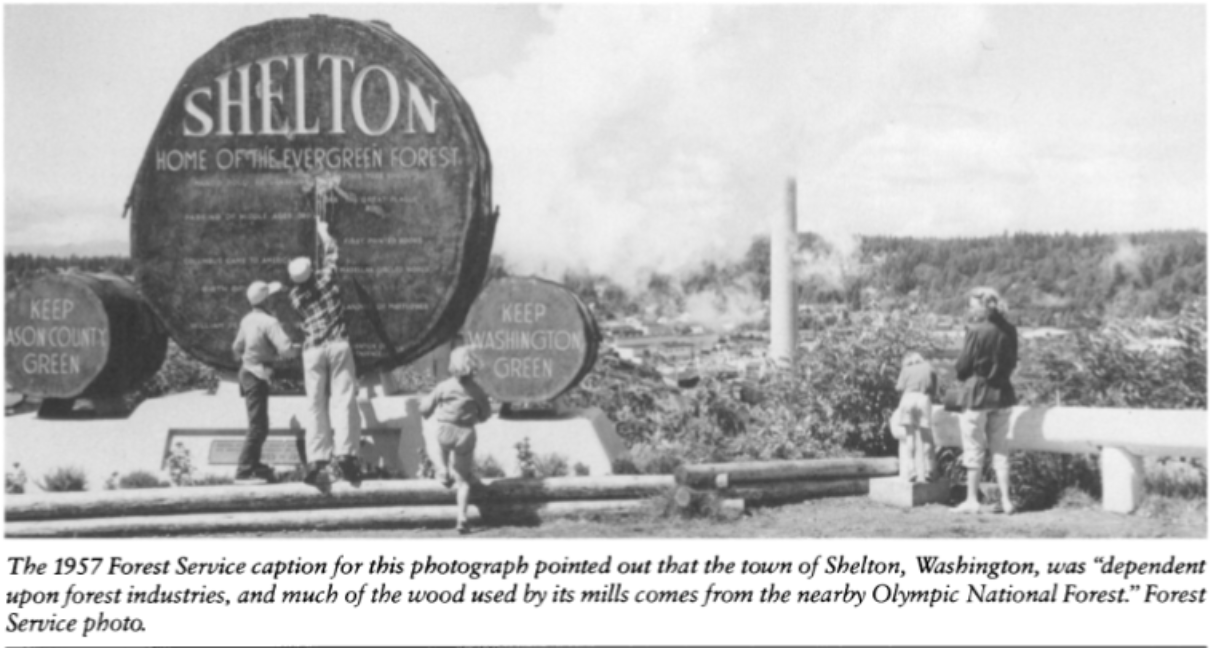
The Sustained Yield Act of 1944 was originally designed to stabilize post-war timber towns, yet most units established in the 20th century resulted in mill failure, forest health decline, and industrial consolidation. In New Mexico, the Vallecitos SYU became a 'benevolent autocracy' that excluded the very community it was meant to serve; Washington’s Shelton Cooperative SYU collapsed decades early after creating a corporate timber monopoly that left the town vulnerable. Because of these systemic failures, the Forest Service has not established a new SYU in 76 years. Reviving this antiquated model in 2026—rather than following the only successful, more modern Lakeview Stewardship model (an updated 1950’s SYU that truly incorporated community stability and forest health)—threatens our local economy and ignores nearly a century of management lessons.
While this plan does heavily rely on each forest management plan, the data used to define timber sales in these plans does not include the most recent best available science on the climate trends that prove climate pressure will ultimately limit the regrowth and rebound of forests post-logging.
Re-building the timber economy, supporting ‘stable’ communities and creating sustainable resources in the face of climate change requires more than a logging mandate. We need creative and collaborative solutions with robust public input.
Please write a comment to the provided email for USDA USFS in Helena letting them know what’s really at risk and how we need to learn from past mistakes.
PUBLIC COMMENT DUE APRIL 10th. Please email comments to SM.TriForestSYU@usda.gov
We are deeply concerned that this restrictive public comment process is an indicator of future management, where local community input is treated as a secondary consideration to industrial production quotas. We have many questions regarding how this plan aligns with the diverse needs of our local forest and why the agency is limiting the opportunity for meaningful, local engagement. Yet again, we need your help making sure our community has a voice in the decisions that impact our public lands, local economy, and the Greater Yellowstone Ecosystem as a whole.
Join us in person April 8th at Neptune’s Brewery from 5:30-7:30 PM to learn more to help formulate your comments. Please submit your written comment by April 10th. Thank you for showing up for our wild places, wildlife, and this community.
Please keep reading for more information on this issue, our biggest concerns, and how to engage.
Summary: Montana Tri-Forest Federal Sustained-Yield Unit (SYU)
The Beaverhead-Deerlodge, Custer Gallatin, and Helena-Lewis and Clark National Forests expect to offer a total of 350 million board feet (MMBF) of commercial timber over an initial 10-year period, averaging 35 MMBF annually.
Source: USDA News Release, March 4, 2026
The Unit boundary encompasses approximately 8.3 million acres of National Forest System lands. Within this boundary, the Forest Service has identified 980,477 acres as ‘timber emphasis lands’—areas suitable for timber production where harvesting and removal will be prioritized to meet the Unit's volume goals. (Section B2)
The plan identifies the Sun Mountain Lumber mills (located in Deer Lodge and Livingston, MT) as the largest primary sawlog manufacturing facilities within the Unit. The stated purpose of the SYU is to provide these and other local facilities with a ‘continuous and predictable supply’ of forest products. (Section A2)
The proposed framework clearly states, “In the event that a timber sale or forest products offered within the Unit remains unsold or is deemed over-priced for the market within the Unit, the Forest Supervisors may re-offer that timber or forest products with no limitations on delivering those products to manufacturing facilities located outside the Unit boundary.” (Section C2)
Performance of the Unit is measured by two primary metrics: (1) the volume of timber offered and awarded and (2) the successful delivery of those products to facilities within the Unit. While the plan references existing Forest Plans, it does not establish new, independent mandates for monitoring soil productivity, water quality, or climate-specific regeneration as triggers for adjusting the decadal quota. (Section D).
Official Project Links
Full Draft Management Plan (PDF): Montana Tri-Forest SYU Plan
USFS News & Hearing Information: Official Release March 2026
PCEC’s Biggest Concerns
Right now, this plan prioritizes meeting a logging quota and neglects to consider healthy forest management practices and the long-term stability of our community, a specific goal stated in the plan without any capacity, funding, or monitoring implementation. We request that the Forest Service withdraw this plan and instead conduct a comprehensive Environmental Impact Statement (EIS) covering all designated timber emphasis lands. We request that the agency use 2026 climate and soil moisture data to prove these forests can biologically regenerate and that this level of harvest will not degrade our water resources, wildlife connectivity, or result in the eventual liquidation of the resource and the abandonment of our local mills, as we have seen previously in the history of SYUs in the USFS.
We need the Tri-Forest SYU Management Plan to clearly state how community stewardship of the forest will be prioritized and implemented. We request that any future management framework adopt the proven monitoring standards for community stability and forest health seen in the Lakeview Federal Sustained-Yield Unit (Oregon), the only success story found from the 1944 SYU experiments. This would need to include dedicated funding for collaborative monitoring, a focus on restoration-based byproduct utilization, rather than industrial sawlog mandates, and transparent administrative markers that prove an intent to support a diversified local economy and a sustained resource.
This means the forest's ecological needs dictate what comes out and goes in, rather than a mill's quarterly quota dictating these standards.
By combining the 1944 Sustained Yield Act with the modern Emergency Situation Determination (ESD), the Forest Service is effectively creating a mechanism that silences the community: the SYU mandates a 10-year industrial quota while the ESD removes the public’s right to challenge it. If the DNRC Good Neighbor Authority is the main contractor, and the ESD is the shortcut, the community and public are no longer partners—we are just an obstacle in a production line.
The other compounding issue is the Emergency Situation Determination (ESD). On April 3, 2025, the Secretary of Agriculture issued a Memorandum, declaring a 'forest health crisis' across 112 million acres—including the Custer Gallatin National Forest. By invoking Section 40807 of the Infrastructure Investment and Jobs Act, this declaration allows the Forest Service to bypass the standard 45-day pre-decisional objection period for individual projects.
When combining this emergency shortcut with the 10-year logging mandate of the Tri-Forest SYU, it effectively silences community input before the saws ever hit the ground.
How to Engage: Deadlines and Details
We need your help to ensure the Forest Service hears the voice of the community, not just industrial interests.
1. REGISTER for Oral Testimony: If you wish to speak at the public hearing, you must register by 11:59 PM March 31st.
Link to Register: [Forest Service Public Engagement Portal - Tri-Forest SYU]
Note: Speaking slots are limited and assigned on a first-come, first-served basis.
2. ATTEND THE PUBLIC HEARING: Provide your oral testimony in person or listen to the proceedings.
Date: April 1, 2026
Time: 9:00 AM – 4:00 PM (MDT)
Location: Delta Hotels Helena Colonial, 2301 Colonial Dr, Helena, MT 59601
3. SUBMIT WRITTEN COMMENTS: Even if you cannot attend the hearing, your written comments are essential for the legal record.
Deadline: All comments must be received by April 10, 2026.
Email to: SM.TriForestSYU@usda.gov
Subject Line: FORMAL OBJECTION: Montana Tri-Forest SYU Establishment
4. KEY TALKING POINTS
Demand an EIS: Tell the agency that a project spanning 8.3 million acres requires a full Environmental Impact Statement, not a streamlined checklist.
Focus on Climate: Remind them that 2026 data shows a 2-3°F temperature rise that makes 1944 growth models obsolete.
Protect Local Stewardship: Demand that the agency adopt the Lakeview Oregon Monitoring Standards to prioritize forest health over volume quotas.
Specific Objections and Resources
We object to the proposed SYU Management Plan because it fails to incorporate the best available science regarding climate change and forest regeneration.
Recent studies (Dobrowski et al. 2025/2026) show that 20% of low-elevation conifer forests in the Northern Rockies are now at high risk of regeneration failure due to soil moisture deficits. The 1944 Act assumes trees will always grow back at a predictable rate, but 2024 Montana Climate Assessment data confirms a 2.0–3.0°F temperature rise that makes previous growth models obsolete. Read the research, Dobrowski et al. (2025) - Identifying Environmental Constraints on Reforestation and the newest Montana Climate Assessment (MCA) - 2024 Temperature Trends.
The proposed mechanical harvesting threatens our local water supply. H.J. Andrews Experimental Forest research shows mechanical harvesting can reduce soil hydraulic conductivity by 99%, leading to flash flooding watersheds that threaten the base flows necessary for the survival of bull trout and westslope cutthroat trout. Read the research, H.J. Andrews Experimental Forest - Impacts of Mechanical Harvesting on Soil.
We also object to the exclusion of critical habitat impacts for protected species. Ignoring the connectivity corridors for Canada Lynx and other Grizzly Bears modeled by Dr. Sarah Sells (University of Montana) constitutes a failure to manage biodiversity under the National Forest Management Act (NFMA). Read the research, Sells et al. (2022/2023) - Predicted Connectivity Pathways between Grizzly Bear Ecosystems.
We object to the combination of the Sustained Yield Unit and use of the Emergency Situation Determination (ESD) in order to bypass meaningful environmental review.
Since the 2024 CEQ NEPA updates, the Forest Service has increasingly used Emergency Situation Determinations (ESDs) to bypass the 36 CFR 218 pre-decisional objection process. By applying an ESD authorized under the Bipartisan Infrastructure Law, the Forest Service is removing the 45-day objection window that the Tri-Forest SYU Plan claims each project will receive.
We further object to the small project exemption from NEPA that allows projects under 3,000 acres to require no standard review or public process. This lacks a reasoned basis, as highlighted by the January 23, 2026, District Court ruling (Case No. 23-cv-01426-AA) which recently vacated similar categorical exclusions for failing to provide adequate environmental analysis. Read more about this in the article by Courthouse News, Judge strikes down Forest Service logging loophole.
Historically, the public’s right to object before a decision is signed is the primary check on agency overreach. In the 1970s, the Grays Harbor (Shelton) Unit used similar fast-tracked operations that eventually led to abandoned mills when economic planning failed to account for actual market demand.
We object to the proposed SYU Management Plan because it contains significant internal contradictions, ignores the failure of past SYU’s with no feedback loop, and fails to provide adequate monitoring for its stated objectives.
The plan in Section D contains a bypass option allowing unsold timber to be offered outside the Unit without limitation. This contradicts the stated goal of anchoring local infrastructure and suggests that over supply and market limitations will not reduce timber remover and the Unit’s true intent is general volume production rather than community or industry stability.
Sustained yield requires a feedback loop; it cannot be a static 10-year mandate. A management plan without a feedback loop is technically asset liquidation, not sustained yield. The historical failure of the Shelton Sustained-Yield Unit (terminated in 2002) proves that when an agency prioritizes a fixed industrial quota over biological growth rates, it eventually exhausts the resource. In Shelton, the lack of a mechanism to adjust the 'cut' based on actual forest health led to the liquidation of the resources and the eventual closure of the very mills the plan was meant to protect. We object to a Tri-Forest plan that replicates this 'fixed-quota' mistake without a legally binding requirement to reduce harvest levels when monitoring shows regeneration failure or declining soil moisture. Read more about the only examples of a SYU being changed to sustain the local community, Lakeview Stewardship Group - Multi-Party Monitoring Reports and Collaborative Management Plan (This documents and resources how monitoring forest health, rather than just volume, saved their local mill infrastructure).
Forest health and community stability are clearly stated goals with no plan or monitoring, or standard to measure success or adapt if not being achieved, this leads us to believe this is not an intent at all due this obvious focus on volume and shipment to production.
We object to the established production quotas relying on arbitrary economic modeling, the failure to account for systemic market consolidation, and the failure to account for the cumulative impact of the current Good Neighbor Authority (GNA).
Regional economic reports (2026 BBER capacity study) show that Montana mills are already operating with significant unused capacity (approx. 26%). This confirms that the regional bottleneck is a lack of market demand, not a lack of federal supply. Read more about the University of Montana BBER - Forest Products Solutions (Refer specifically to the 2026 Region 1 Capacity and Capability Report).
Our concern is that the Draft Management Plan (Page 2) relies on the Good Neighbor Authority (GNA) to meet its timber quotas, effectively turning the Montana DNRC into an implementation arm for the Forest Service. This creates a self-funding bureaucratic treadmill where timber revenue must fund the very staff tasked with marking more trees. Currently, the state is already under a 2025 Shared Stewardship Agreement mandate to produce 100 MMBF annually through GNA. By adding a 35 MMBF SYU quota on top of this, the agencies are bypassing a cumulative analysis of what our local watersheds can actually sustain. Read more about the DNRC Good Neighbor Authority.