What a Bear-Inspired Dinner Taught Us
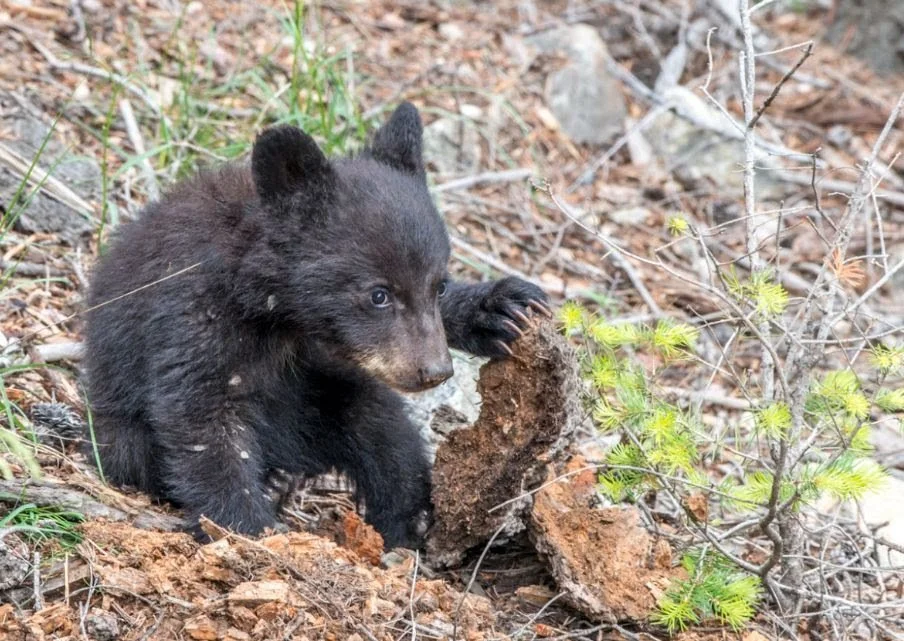
Black bear cub turning bark over looking for food–Photo by Tom Murphy
This past Saturday, I joined community members at Crazy’s, a cafe in Clyde Park, to share a meal honoring the bears we live alongside. Seated family style, we enjoyed a menu curated by Chef Gabrielle Johansson: Trout Cakes with Lemon Sage, Rye Bread with Roasted Mushrooms, Sausage and Apple Cider Sauce, and Honey Cheesecake with Chokecherries. Each dish was inspired by the preferred foods bears forage for in the wild: all abundant food sources in a normal year, but which have come up short this year after a dry winter and a late spring freeze.
Right now, hungry and running out of time to build fat reserves before winter, bears are moving closer to people, raiding garbage, compost, bird feeders, fruit trees and any other calorie-rich food they can find.
“Bears aren’t just going to sit up in the hills and allow themselves to starve,” explains Evan Stout, who runs Bear Awareness Gardiner (BAG) with Blakeley Adkins. “When natural foods fail, the bears keep searching, and eventually that search is going to lead them into our communities."
Around the dinner table we heard tales of kids chasing bears out of town. The stories may be exaggerated, but the worry behind them isn’t: bears of any species that lose their wariness of people can become dangerous. While it can be thrilling to see a bear up close, habituation and food conditioning are first and foremost a community safety issue, and we should all view it through that lens.

A bear eating easily accessible trash in Gardiner–Photo Courtesy of Evan Stout
I chatted with Stout and Adkins about all the bears we’ve been seeing near our community this year. “You’ll hear a lot of people say that we have a bear problem,” Stout says. “These conflicts stem from human behavior. It’s not a bear problem. It’s a human problem, and we need to change some of our behavior to keep the bears out of trouble.”
Securing trash is the best thing we can do to keep our community safe. Finding food is what bears do best, and once they find a food source, they return to it again and again. If we secure our attractants, bears are far less likely to stay in our communities. Instead, they’ll keep passing through and look for food elsewhere.
Here’s where you can help: BAG and PCEC are currently raising funds for bear-resistant trash infrastructure at Shields Valley High School. Clyde Park has seen a lot of bear activity in town and around the school–a place where kids, staff and families gather every day. Bear-resistant infrastructure is expensive, but it works, and helps keep communities safe.
Please consider donating here to help keep students, staff, families and bears safe in Clyde Park. The funds raised will go towards purchasing bear-resistant dumpsters and trash cans. Every $10 you donate earns one entry in our Bear-Safe Raffle for the chance to win an Ursack Bear-Resistant Food Sack and a Bear Spray Training Kits (one Counter Assault bear spray and one Frontiersman Inert practice canister). The raffle closes October 31, and we’ll announce our two lucky prize winners.
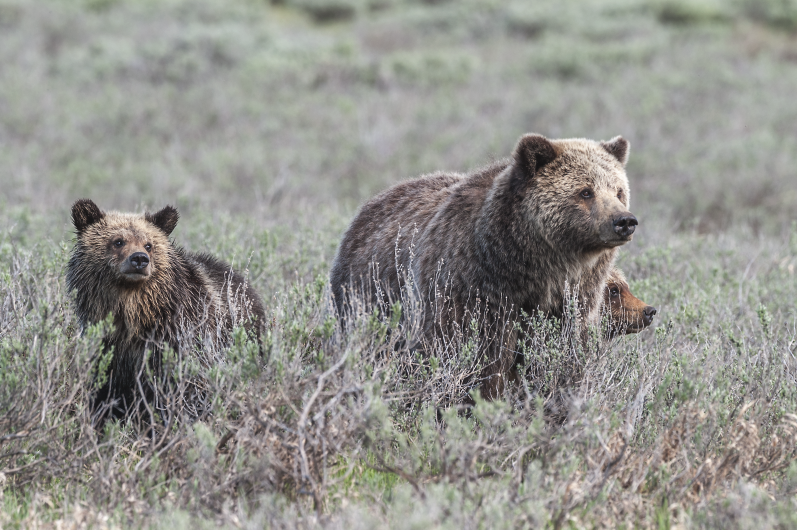
Grizzly Bear Sow and Cubs–Photo by Tom Murphy
Black bears and grizzlies are part of what makes Montana special, and living close enough that one could wander into town is a privilege. With that comes a responsibility to secure bear attractants so this stays a place where bears can thrive alongside us.
Adkins has a straightforward message for our community: “If you have a bear actively at your property eating attractants, do something about it. Don’t just take pictures. That won’t help. Secure the attractants.”
It’s up to all of us to make sure our neighborhoods are free of bear attractants. When we do nothing, the consequences are often lethal for bears. “There are solutions to a lot of these problems that everybody’s seeing and feeling right now, but it takes the community, and it takes everyone doing their part to get a lot of them solved,” Stout says.
That kind of collective effort can be hard to picture in our fast-paced world, but this past Saturday, inside a small cafe, I felt our community’s pulse, alive and well. Crazy’s Saturday Night Dinner–a weekly community gathering started by cafe owner Matt Chambers–offers a space to slow down and connect. Through food, art, storytelling and casual conversations, the evening reminded us what it means to share this landscape with bears, honoring both the challenges and the beauty.
Sitting elbow to elbow with neighbors, artists, musicians, writers, chefs, ski patrollers, and conservation advocates, working together to protect our community and bears didn’t just feel possible. It felt like something we were already doing.
P.S. The Bear-Safe Raffle closes October 31. Enter by donating to the Shields Valley School Bear-Safe Fund here.
For help securing bear attractants contact BAG:
Evan Stout: evan@yellowstonewildlifeguidecompany.com
Blakeley Adkins: adkins.blakeley@gmail.com
Read more about BAG and their work in our community below.
What to do if you see a bear in town:
Do not approach the bear and do not feed the bear. In Montana, it's illegal to intentionally feed wildlife.
Someone is in danger or the bear is an immediate public safety threat or threat to property: Call 911.
The bear is passing through and looks like it’s leaving: Let it go and report the bear to your local Fish Wildlife & Parks (FWP) by calling 406-577-7900, especially if it's a grizzly.
A bear is sleeping in town (for example, in a backyard): Call your local FWP office 406-577-7900.
A bear is hanging around town but isn’t a threat: Call your local FWP office 406-577-7900.
You see signs of a bear, like trash knocked over again and again: Call the city and ask for bear-resistant trash cans. Recommend to your neighbors to keep their trash inside a shed or garage until morning of pick-up.
Partner Spotlight: Bear Awareness Gardiner
Bear Awareness Gardiner (BAG) formed in 2009 as a community-led program under Bear Creek Council to reduce human-bear conflicts in the Gardiner Basin. The program lost momentum over the next several years, and in 2021, Evan Stout, a wildlife guide frustrated by the conflicts he saw around town, took over. Under his leadership, BAG has grown significantly over the past five years, and Blakeley Adkins has since joined the team. Their work has paid off: Gardiner is in a much better place when it comes to human-bear conflicts, which has allowed BAG to expand its efforts to neighboring communities, including Paradise Valley, Cooke City/Silvergate and Livingston.
BAG works with communities to provide and maintain bear-resistant trash infrastructure. In Gardiner, any resident can get a free bear-resistant trash can through a program BAG started, and in Cooke City, Silvergate and Paradise Valley, BAG helps coordinate solutions suited to each community. In Paradise Valley, BAG also funds and coordinates upgrades to the community dumpster sites known as “green boxes,” where aging enclosures can turn a lifeline for rural residents into an easy meal for bears.
Securing trash is the first step for BAG, and fruit trees are the next step. Apples are a delicious meal for bears, and many people don’t realize the risk that unharvested fruit poses as a bear attractant. BAG’s fruit gleaning program helps to pick that fruit before it becomes a problem. Once trash and fruit trees are secured, additional backyard attractants like beehives, chicken coops and bird feeders are next in line.
Whether it means taking attractants out of the landscape or putting an electric fence around them, the goal is the same: make sure bears don’t find an easy meal and a reason to stay in human-populated areas. BAG subsidizes and installs electric fencing for homeowners, livestock owners, beekeepers and orchardists. The group has built around 40 fences in the last two years and around 60 since the program began, stretching from Gardiner through Paradise Valley and into Cooke City.
PCEC is proud to partner with BAG and work together to support FWP in reducing human-bear conflicts and empower our community to be good neighbors to each other and to the bears we share this landscape with.