Changes for Grizzly Bears & Community Needs
The public comment deadline regarding changes to grizzly bear management closes on August 17th. As the U.S. Fish and Wildlife Service proposes major revisions to Section 4(d) of the Endangered Species Act, now is the time to make our community’s voice heard to ensure true, long-term grizzly bear recovery.
Lasting recovery occurs when management stays rooted in peer-reviewed science and cross-boundary stewardship. This exact approach successfully restored landmark species like the Bald Eagle and Peregrine Falcon. The proposed Section 4(d) rule strays from these proven models by leaving critical management decisions at risk to state political agendas rather than biological data and community needs.
Effective wildlife stewardship requires holding two priorities at once: supporting the local landowners and wildlife specialists who manage day-to-day coexistence, while keeping strong federal sideboards in place to protect vital habitat corridors and cross-boundary coordination.
Delegating broad conflict management to the state without enforceable federal coordination leaves local wildlife policies vulnerable to shifting political agendas in Helena rather than grounded in stable science and community needs. Without binding commitments to support connected vital open landscapes and fund non-lethal tools, transferring operational authority creates unnecessary uncertainty for both communities and moving bears.
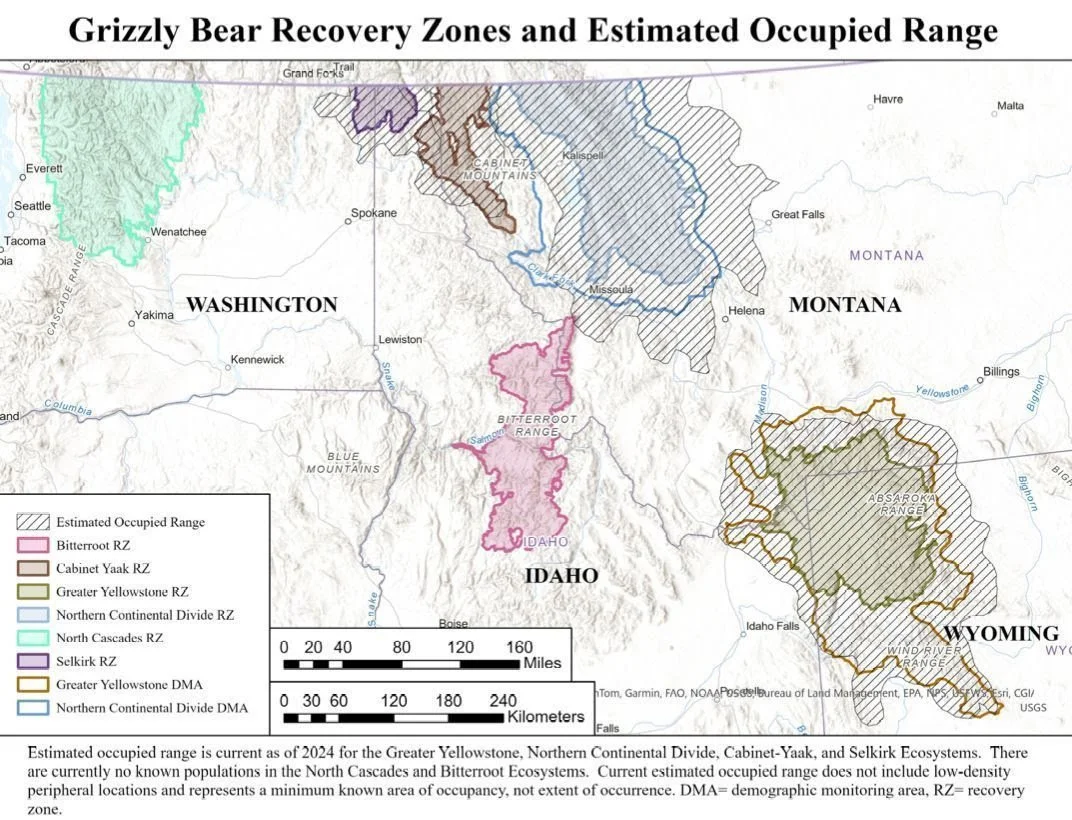
Map displaying official federal recovery zones alongside current estimated occupied range across Washington, Idaho, Montana, and Wyoming. (Source: Dr. Christopher Servheen 2024 Report / USFWS)
Our Recommendations
We are advocating for a path toward long-term resilience, practical coexistence, and true co-stewardship on the ground. In our official public comments to the USFWS, we are requesting these essential safeguards in upcoming changes to grizzly bear management:
Require public review for any future joint state-federal management agreements so gateway communities have a voice.
Require states to establish dedicated funding mechanisms for non-lethal coexistence tools as a prerequisite for Tier 2 management authority.
Support funding for binding protections for agricultural open space and migration corridors prior turning authority over to states.
Maintain federal safeguards until genetic testing proves northern continental divide and Yellowstone grizzlies are naturally breeding on their own in the wild.
Maintain federal safeguards and keep wolf trapping closed during grizzly non-denning months so active grizzlies aren't accidentally trapped or injured.
Replace non-binding tribal consultation with enforceable co-management agreements that give Sovereign Nations voting power on interagency management boards, direct access to monitoring data, and sustained federal capacity funding for Tribal wildlife staff.
You can read the official notices and submit your own public comment before the August 17, 2026 deadline through the federal portal at fws.gov/grizzlyrulemaking.
Living in bear country comes with real risks and hard conversations. We have a unique opportunity to show what true community-led stewardship looks like in practice. Please help us be a voice for our local communities, both human and wild!
Park County’s Critical Role & Lessons from Wildlife Management
Park County plays an extremely important role in connecting the Greater Yellowstone Ecosystem to the Northern Continental Divide Ecosystem and the rest of the Northern Rockies. The Greater Yellowstone grizzly population remains isolated as a genetic island, meaning bears moving north out of Yellowstone National Park need to be able to travel safely through Paradise and the Shields Valley to reach northern populations for long-term genetic health. Natural genetic connectivity means strengthening biological resilience, giving these bears the genetic diversity they need to fight off diseases, adapt to changing food supplies, and survive current pressures of climate change.
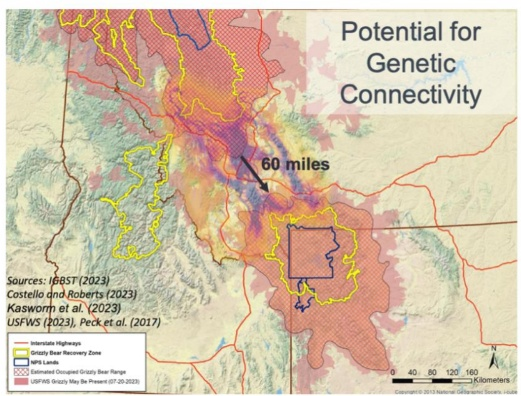
Map illustrating the estimated occupied ranges and recovery zones of western Montana and the Greater Yellowstone Ecosystem, depicting the approximate 60-mile gap separating the two populations. (Source: Costello & Roberts via Dr. Christopher Servheen 2024 Report)
According to research by Dr. Sarah Sells (USGS / University of Montana) and monitoring data from Montana FWP, individual subadult male bears are moving outside official recovery zones into areas like the Big Hole Valley, Pioneer Mountains, and Bangtail Range. The Interagency Grizzly Bear Study Team confirms that natural genetic exchange through wild reproduction has not occurred in the Greater Yellowstone population. A male bear moving through a valley does not establish genetic connectivity until they reproduce with a resident female.
Private working lands, vast open spaces, and intact river corridors form the physical bridges needed for grizzlies to move and reproduce across the landscape. Protecting these corridors prevents habitat fragmentation from misguided growth, preserving the biological bridge grizzlies need and the agricultural heritage that defines Montana.
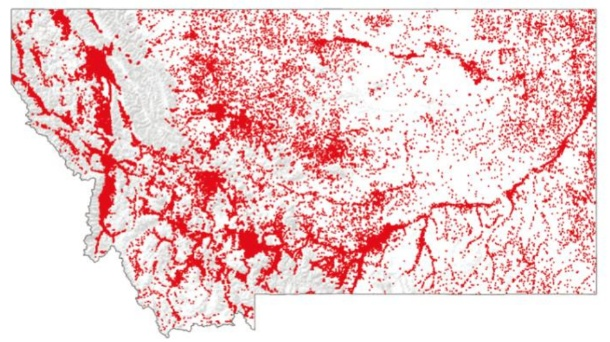
Map illustrating the distribution of human infrastructure and development density (red). (Source: Headwater Economics)
What Is Changing & Community Stewardship Needs
The U.S. Fish and Wildlife Service is proposing a revised Endangered Species Act Section 4(d) rule that creates a two-tiered management framework:
Tier 1 maintains direct federal oversight where recovery goals are not yet met. Tier 2 delegates day-to-day conflict handling, relocation, and lethal control discretion to state and tribal agencies where numerical recovery targets are achieved, such as the Greater Yellowstone and Northern Continental Divide ecosystems.
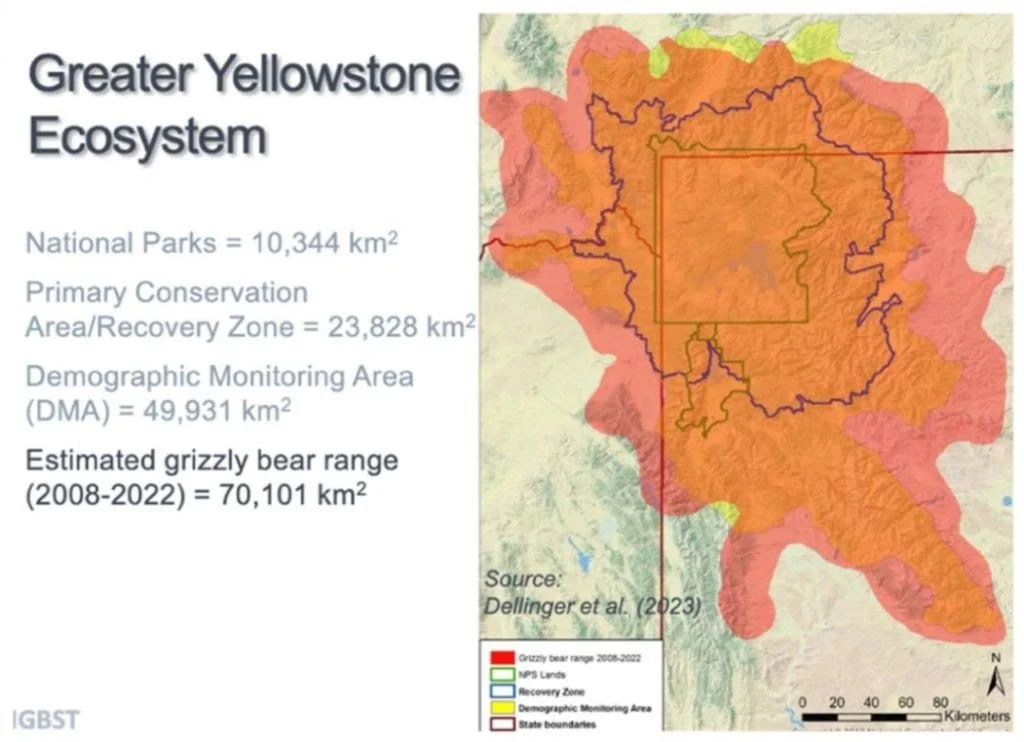
Map defining the spatial extent of National Park Service lands, the Primary Conservation Area/Recovery Zone, the Demographic Monitoring Area, and the estimated grizzly bear range from 2008–2022. (Source: Dellinger et al. 2023 via Dr. Christopher Servheen 2024 Report)
Under the Endangered Species Act, "take" means to harass, harm, pursue, capture, wound, or kill a protected animal. Current rules permit take only under certain circumstances, primarily self-defense, non-lethal research, and official agency removals of documented conflict bears. The proposal expands legal exceptions by loosening non-lethal hazing rules and shielding state-regulated trappers if a bear is accidentally caught or killed. It also gives state managers broad discretion to move or euthanize bears in Tier 2 areas without case-by-case federal approval. These changes are crucial because critical management thresholds, safety triggers, and conflict protocols are removed from the regulation itself and deferred to future, undisclosed interagency Memorandums of Understanding without public process.
Research from Headwaters Economics shows that Montana faces a major funding deficit for proactive non-lethal coexistence tools in its current role. Handing discretion over to the state without enforceable funding mandates leaves local ranchers and gateway communities to absorb those costs alone.
The proposal does not change the grizzlies listed status as Threatened under the Endangered Species Act, and the rule does not legalize state trophy hunting.
Current Mortality Rates
Across the Greater Yellowstone Ecosystem, documented mortalities have hit record highs in recent years— 70-77 confirmed deaths annually in 2021, 2024, and 2025, largely on private lands. According to long-term data from the Interagency Grizzly Bear Study Team and USGS, approximately 85% of all adult grizzly bear deaths in the Greater Yellowstone Ecosystem are human-caused. Grizzlies have one of the lowest reproductive rates of any mammal in North America, with nearly 50% of cubs dying in their first year. Mortality rates spike sharply in the fall during hyperphagia, when foraging bears move to lower elevations and encounter unsecured attractants, highway traffic, and big-game hunters. Because the species has virtually no biological buffer for accelerated losses, maintaining non-lethal conflict tools on private lands is the single most critical factor in keeping local mortality rates sustainable.
Promoting Cross-boundary Stewardship & Honoring Sovereign Nations
We need to maintain strong federal safety nets so state political agendas cannot strip away habitat protections, impact cross-boundary management, sovereign engagement, or shift costs burden to local communities. Not just in Montana, but across the West.
True coexistence and stewardship means honoring those who managed this land long before state lines existed. In 2016, leaders from over two hundred Sovereign Nations signed The Grizzly: A Treaty of Cooperation, Cultural Revitalization and Restoration, creating the most widely signed inter-tribal agreement in modern history. We advocate for a tri-party co-stewardship (management) model among Federal, State, and Tribal leaders. Grizzly bear habitat spans federal, state, tribal, and private lands, strong federal coordination across boundaries remains essential to prevent management protocols and relocation options from breaking down across state lines.
Please help us keep Park County communities and grizzly bears safe, comment today.