Collaborating on Cows and Creeks
On a glorious 60°F February day, I joined a group of land stewards packed into the Shane Center Ballroom to discuss grazing management in riparian areas. With the thought of drought lingering in the back of my mind, the opportunity for open dialogue centered around resource management felt particularly pressing. While I learned an immense amount about grazing management in riparian areas, what stuck with me most had little to do with cows or creeks, but with the interactions between the people in the room.
I recently joined the PCEC team to serve the Park County community through the Big Sky Watershed Corps program and the Barbara Hays Conservation Fellowship. My work is focused on watershed restoration, education, and community-based conservation. I was thrilled to attend this workshop with so many important Upper Yellowstone Watershed stewards working to bridge the gap between the interactions restoration practitioners and land managers have with critical ecosystems.
The folks at the workshop ranged from scientists concentrated on ecosystem restoration to ranchers focused on landscape productivity. The split between us was clear, from the way we dressed–Patagonia fleeces contrasting Carhartt vests–to the way we pronounced creek. Yet, the division among us wasn’t a hurdle to overcome; it was the very reason we all gathered for the workshop. While the mechanisms of our work may differ, it became clear that we all share the same goal: leaving the land in better shape than we found it.
Putting aside our differences and recognizing our common ground is one of our strongest tools for conservation. We often talk about restoring the land to a past state. But after hearing from the folks in the room, it’s apparent that we shouldn’t be looking backwards. We are forging a path forward of land management rooted in constant observation, shared knowledge, and the courage to try something different every now and then.
The workshop was co-hosted by Ashley Brubaker (Trout Unlimited Project Manager) and Danielle Proctor (Upper Yellowstone Watershed Group Coordinator). Inspiration to hold the workshop spurred when Dustin Homan (Shields Valley agricultural producer and Park Conservation District Board Supervisor) visited one of Brubaker’s stream restoration project sites for a permit inspection. Restoration project sites on grazing land can lead to tension between the needs of a healthy ecosystem and the priorities of working land.
While many schools of thought may suggest fencing off riparian areas from any outside disturbance, Brubaker has observed that fencing cows out of creeks isn’t always realistic or the best solution. She recalls asking Homan about grazing management during his visit: “we could have stayed there all day talking about how to move cows around the site to the best benefit of the creek and the cows.” Recognizing the value of their stream-side conversation led to the creation of this collaborative workshop focused on learning about different management strategies from people with experience and knowledge of grazing.
The day kicked off with a presentation on riparian area grazing from Dr. Jeff Mosley–Professor of Rangeland Ecology and Management and MSU Extension Range Management Specialist. After a lunchbreak, we reconvened for a Q&A session with a panel featuring four Park County ranchers: Dustin Homan, Mark Rose, Ned Zimmerman, and Meagan Lannan. Throughout the workshop, we recognized the importance of grazing with intent, trading rigid management rules for creative place-based solutions, and that a healthy creek and a profitable ranch are two sides of the same coin.
My background is rooted in ecology, and my passion for land stewardship stems from my love for outdoor recreation and a deep connection to the natural world; however, I’ve always thought that in another life I would be a rancher. I value hard work and cherish learning from the land. While I can easily romanticize prowling my pastures on horseback, the reality of ranching is back breaking work in constantly changing conditions with highly unpredictable profitability. “It’s miserable to do that job if you don’t like doing it,” Ned Zimmerman, Wilsall Rancher, said, “If you love ranching, it’s the greatest thing in the world.”
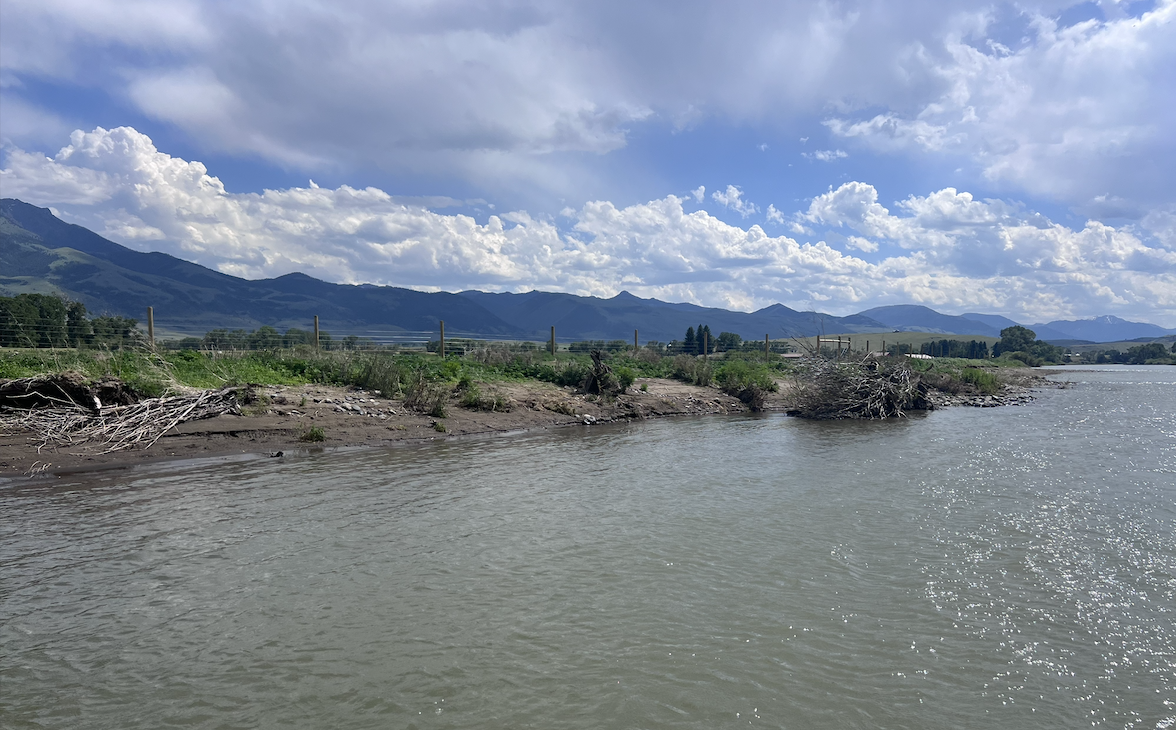
The livelihoods of ranchers greatly depend on a healthy and productive landscape. Situated in these landscapes are riparian areas–heavily vegetated, unique habitats alongside bodies of water that provide critical ecosystem benefits. The moist soil supports vegetation that stabilizes streambanks, enhances water quality by filtering excess nutrients and sediment, recharges groundwater, and supports diverse ecosystems. The lush vegetation, drinking water, and shade lures grazing ungulates to these highly-productive habitats. The draw of these zones creates a vulnerability for excessive grazing and landscape degradation.
Cows are selective grazers. When they’re in a large area, they’ll only eat what tastes best to them. If the cows aren’t moved, they’ll eat the nutrient-dense plants to the ground, not allowing time for proper regrowth. When vegetation is removed faster than it can recover, it leads to increased soil erosion, reduced water filtration, and loss of plant diversity. However, when cows graze in a small pasture for a short period of time, it limits their selective nature, and they’ll eat everything that’s edible. When moved frequently and managed to graze in a non-selective manner, cows' presence on the land can improve plant and soil health. “Grazing is a natural process,” Dr. Mosely stated, “There’s definitely problems from too much, but there are also problems from too little, so total exclusion is not the answer. The answer is trying to find the sweet spot.”
To try to facilitate the optimal amount of grazing, land managers have started to utilize high-intensity grazing followed by long periods of rest. Meagan Lannan, with Barney Creek Livestock, spoke on their use of “flash grazing” in riparian areas, which she described as “lots of cows, really fast.” So fast that they might only have their cattle in a pasture for a day and not return to that pasture for two to three years. “We’ve seen a lot of aspen regrowth come out [of flash grazing],” Lannan said, “This speaks to when you use cows as a tool, you’re being adaptive, and you’re watching what you’re doing, it can be very powerful.”
Lannan’s story of cows helping restore the landscape is the dream scenario. The other panelists also spoke about how they’ve seen an increase in wildlife species diversity through their management practices: providing supplemental feed and water tanks, herding tactics, seasonal timing and duration of grazing. Unfortunately, a perfect set of guidelines for grazing management in riparian areas doesn’t exist. Conditions are always changing, and no two operations function in the same manner. “There isn’t one simple recipe for success,” Dr. Mosely said, “Each situation is unique and requires its own creative, locally tailored solutions.”
It may be frustrating that there isn’t a simple answer on how to best manage grazing in riparian areas. Adaptive management requires working with, being open to, and learning from the complexities of natural systems. We are moving away from rigid timelines and strict rules, and instead grazing with intent and listening to what the land is telling us. As we continue to evolve our land management practices, it’s critical to rely on building relationships with people who have varying backgrounds and experiences to increase our wealth of knowledge. Ensuring a healthy and productive landscape for future generations is a lofty goal that cannot be achieved in isolation. “It’s a matter of finding the right people to help you,” Mark Rose, BBar Land and Livestock Manager, said, “People are happy to share their information with you and help you.”
Future conservation success in Park County won’t be found in a manual. It’ll be found in the conversations and relationships we build with each other. During a time when our country feels extremely divided, this workshop felt like a breath of fresh air. I was reminded that our community is full of people who deeply care about protecting our natural resources and want to learn from and understand each other's perspectives. While I might hyper-fixate on the ecological importance of healthy riparian areas, it’s extremely valuable to take a step back and consider the greater implications at play–such as the livelihood of ranchers–before imposing my own land management goals.
Conservation always starts with the people. When people get together, share stories, and learn from each other, we all benefit. In a world of uncertainty, real collaboration starts with trust and admiration. If we are going to build a future together, we might just need to listen a little more, talk a little less, and acknowledge that no matter how we pronounce creek, we all value a healthy stream with clean water.