DEQ Railroad Cleanup Update: April 14th Livingston Town Hall
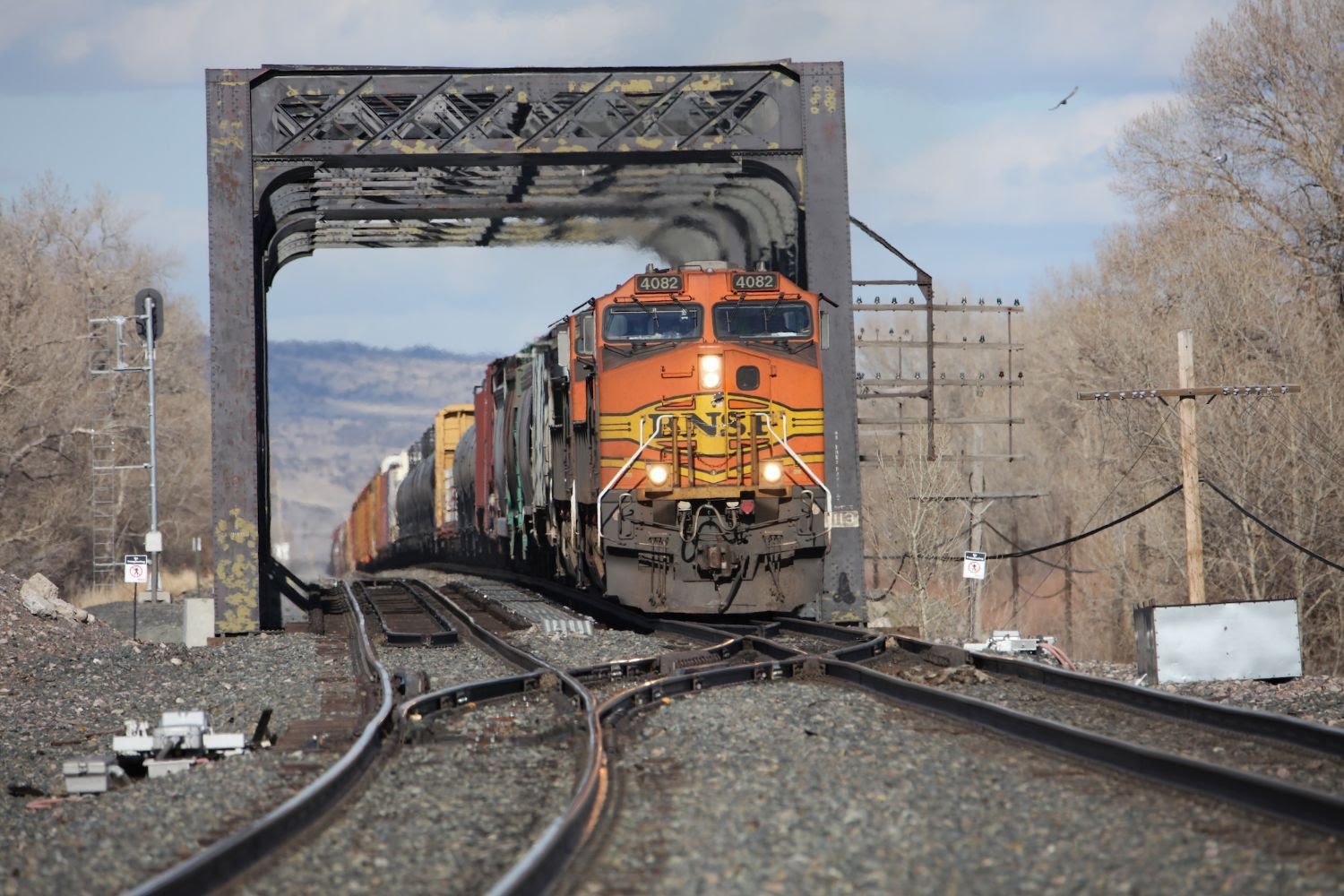
Train crosses bridge over the Yellowstone River in Livingston Montana.
Photo taken by Tom Shands
For those who call Livingston home, the rail yard is a permanent part of our daily landscape. As many of you know, it has also been a long-standing source of soil and groundwater contamination including chlorinated solvents like Tetrachloroethylene (PCE), petroleum, lead, asbestos, and others. While the work to clean up these sites has been ongoing for years, it’s a slow process that can often feel invisible.
The Montana Department of Environmental Quality (DEQ) is returning to Livingston to provide an update on the cleanup, and this event deserves a big turnout from the community. An updated Fact Sheet was published yesterday.
Event Details
What: DEQ Presentation on the BNSF Shop Complex
When: Tuesday, April 14, 2026, 6:30 p.m.
Where: Park County Senior Center (206 S Main St) or ZOOM
The evening will start with a presentation by the DEQ, followed by a Q&A session where you can ask questions directly. DEQ contact details below.
We hope to learn about:
Remediation Progress: In 2023, PCE had migrated into the deeper bedrock groundwater—areas previously thought to be impermeable. Plans were discussed to pilot test new remediation technologies to more aggressively target persistent contaminants and inform the next cleanup phase.
Additional Monitoring Sites: In March 2026, BNSF installed two additional monitoring wells (one alluvial and one shallow bedrock) and five vapor monitoring points (air quality) to address data gaps.
Updated Risk Assessment: In September 2024, DEQ mandated BNSF to amend the initial site risk assessment in 1993 to account for new contaminants, updated toxicity standards, and the impact of previous cleanup efforts. Expected by late 2026, this assessment will identify remaining "unacceptable risk" areas - regarding human and environmental health, establish updated cleanup levels, and include a formal period for public comment before DEQ finalization.
Learn more about PCE below
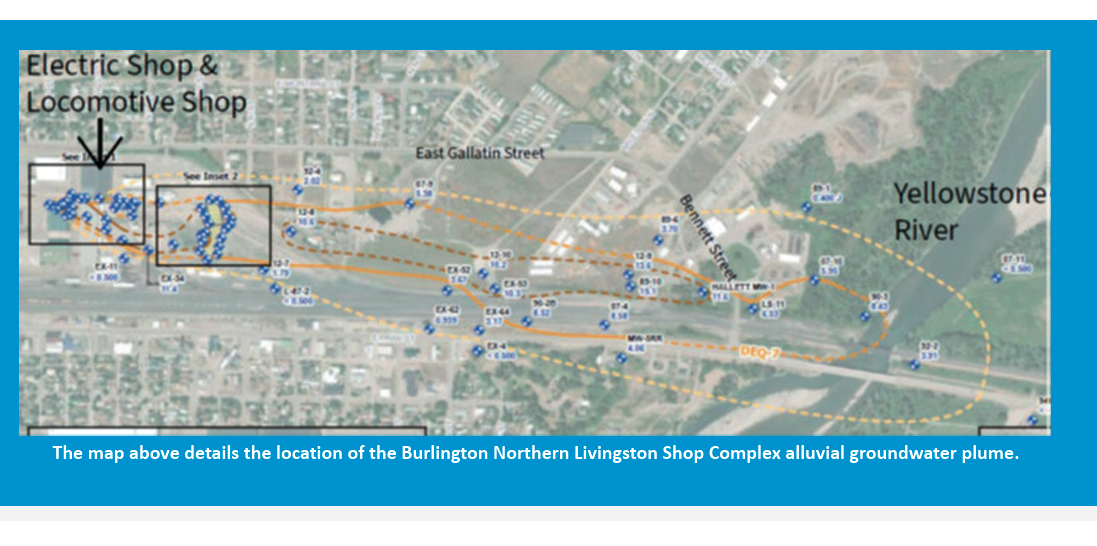
The June 2025 alluvial groundwater plume, provided by DEQ BN Livingston Shop Complex April 2026 Update
Why this meeting is important
It has been nearly three years since DEQ last provided an update, in June 2023. Whether we’re talking about the main Shop Complex or the Mission Wye Facility, these State Superfund sites need our eyes and ears to ensure we stay informed, the cleanup stays on track and our water remains protected.
For me, this is also personal. I grew up on the northeast side, right near the site. My family bought meat at C&P Packing, my friends and I played in those neighborhoods, never really thinking about what was in the ground below our feet. Today, I feel a real responsibility to make sure the kids growing up there now have a cleaner, safer environment than we did. Showing up to these meetings together is part of how we make that happen.
Hope to see you there, and keep reading to learn more about our role and a brief summary of the 2023 update.
PCEC's Role
PCEC has been advocating for this cleanup since our founding in 1989. We later took an active role in the process, serving as a community liaison through a Technical Assistance Grant. We have also hosted many public meetings with DEQ, providing updates on the remediation process. We want to continue supporting DEQ working on this and advocate for the ongoing cleanup effort. We understand that the health of our community is inseparable from the health of our ecosystem. As locals, we are the first line of defense in our community when issues like this arise.
Contact DEQ Directly to learn about the Superfund cleanup. Interested parties can be added to the cleanup mailing list, or send questions or concerns to Montana Department of Environmental Quality Environmental Project Officer Denise Martin at (406) 444-5567 or via email at denise.martin@mt.gov.
A summary of the June 2023 DEQ community update:
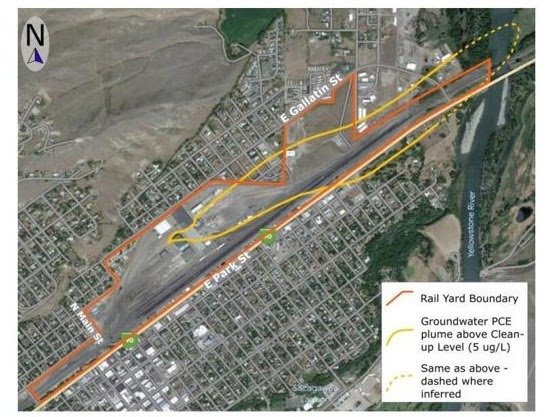
Livingston Superfund site boundaries in 2023 according to the DEQ
Discovery of Bedrock Contamination: Recent investigations revealed that tetrachloroethylene (PCE) has migrated into the deeper bedrock groundwater—areas previously thought to be impermeable. PCE amounts still above the cleanup level of 5 micrograms/liter, and two of the wells showed increases since 2022.
City Water Quality: While contamination is present in the same aquifers used for regional water, city officials confirmed that all active municipal wells are located outside of the contaminant plume. BNSF Railway is required to monitor these boundaries to ensure no encroachment on public or private water systems.
Ongoing Remediation: While the "diesel plume" (oil floating on the water table) has shrunk since 2009, PCE levels remain a primary concern. The DEQ announced plans for pilot testing of new remediation technologies to more aggressively target these persistent contaminants. The DEQ committed to sharing results from these pilot tests and seeking further public comment as they refine the feasibility studies for the next phase of the cleanup.
What is Tetrachloroethylene (PCE)? PCE is a persistent chemical solvent used in dry cleaning and metal degreasing. According to the CDC health statement, PCE is a potential occupational carcinogen that can cause liver damage and respiratory irritation, making its migration into groundwater a significant long-term threat to public health. Because it is heavier than water, it can sink deep into bedrock aquifers and spread through groundwater, posing a long-term threat to drinking water sources and air quality through toxic vapor intrusion. Monitoring and cleaning up PCE is a long process, yet vital to protecting community health and preventing the long-term economic and environmental damage caused by spreading contaminant plumes.