Our Water Is At Risk– TAKE ACTION
Your voice is needed– act now to protect our watersheds as the current federal protections are at risk! We are currently at a critical crossroads for the health of our watershed, based on the data contained in the December 11, 2025, Upper Yellowstone Water Supply Report. While fall precipitation initially improved soil moisture across all elevations, recent unseasonable warmth and rain have turned expected snow into immediate runoff.
This instability is part of a dangerous climatic split across Montana. As we wait for cold temperatures to lock in our moisture, we are witnessing unprecedented mid-winter flooding in Northwestern Montana—while North-central Montana remains gripped by a persistent, intensifying drought.
In Park County, this instability is causing the Yellowstone River to fluctuate wildly rather than following its typical seasonal drop. While the overall basin snowpack appears stable at 100% of the median, it remains below normal at low elevations. This means the water we need to bank in our mountains and aquifers for summer is instead flowing past us now.
Why Your Voice Is Needed
At a time when our water resources are already stressed, the federal government has proposed drastic changes to the "Waters of the United States" (WOTUS) definition that will severely limit the scope of the Clean Water Act (CWA). Stand up for our water and the definition that creates the most protections.
For our community, protecting every small stream and wetland is critical; they are one of our significant remaining buffers against increasing climate variability, helping to store water, moderate floods, and sustain baseflows.
This proposal, intended to align with the recent Supreme Court Sackett decision, introduces rigid standards that would strip federal protection from the vast majority of intermittent and ephemeral streams and seasonal wetlands in Park County. This proposed rule doesn't return power to the state; it simply leaves our local water with no protection at all.
Stripping federal protection from our headwaters removes our first line of defense against extreme weather. Nationally, these changes could result in the loss of up to 80% of wetlands, which act as natural infrastructure capable of storing up to one million gallons of floodwater per acre. For Park County, losing these buffers doesn't just hurt the environment—it shifts the massive financial burden of flood recovery, water treatment, and infrastructure repairs directly onto downstream families and local taxpayers.
While the proposed rule aims to provide clarity and predictability for landowners, it creates a permission to pollute for large-scale industries. This isn't just about 'less regulation'—it’s about who carries the burden when water quality is compromised. If polluters are no longer required to treat waste or manage runoff at the source, our local communities will pay the true cost.
Continue reading below to learn more about the definition changes and what that means for us locally. Please join PCEC, Montana Freshwater Partners, and many others state, regional, and national groups in taking action by submitting your comment electronically by January 5th.
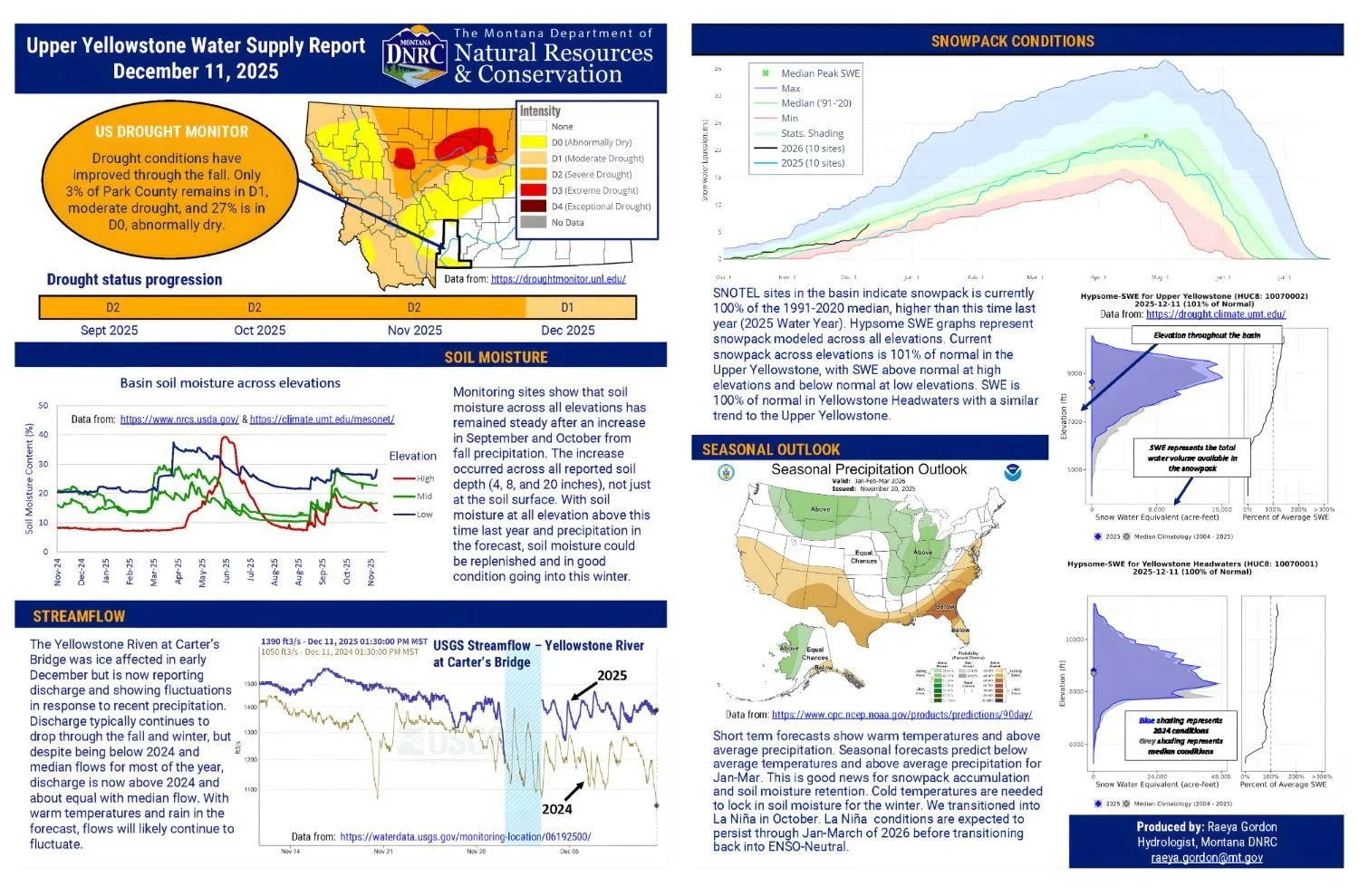
December 11, 2025, Upper Yellowstone Water Supply Report
Park County WOTUS Fact Sheet
The Wet Season Loophole
The proposed changes rely on a rigid wet season—narrowly defined as the period when precipitation exceeds evapotranspiration—to determine if a waterbody is "relatively permanent." This definition ignores the hydrological reality and the actual growing season of the Intermountain West. Here, our peak hydrology is driven by snowmelt and flashy spring weather, typically occurring from April through June. By the time the newly defined "wet season" arrives, our streams may have already provided their most vital contributions to the Yellowstone River's baseflow.
Demolishing Natural Infrastructure
EPA and USGS data show that up to 80% of stream miles in the West are ephemeral or intermittent. These headwater streams feed our major rivers and recharge our groundwater; by stripping their protection, the rule shifts the massive costs of flood recovery, water treatment, and drought impacts onto downstream communities.
Shift in Regulatory Burden &Gap in Protection
While the EPA claims this rule empowers states, the reality in Montana is a dangerous regulatory gap. Montana law (MCA 75-5-203) prohibits our state agencies from implementing water protections that are more stringent than federal law. This means that if the federal government abandons our intermittent streams and wetlands, the Montana DEQ is legally "handcuffed"—they cannot step in to fill the void without a massive legislative overhaul. We are not being empowered; we are being left unprotected.
Downstream Risk
By removing ephemeral streams and headwater protections, the proposal leaves downstream neighbors at risk. In Park County, where development is increasing in ecologically sensitive areas, the loss of these protections leads to decreasing water quality and creates a dangerous regulatory gap.
Groundwater Blind Spot
The rule explicitly excludes all groundwater, threatening the shallow aquifers that are currently in a critical recharge phase. In our alluvial valley, contaminating the groundwater directly impacts the river and our local drinking water.
Key Definition Changes to Challenge:
Continuous Surface Connection: This requires a wetland to be indistinguishable from a river. This ignores functional connectivity—wetlands filter pollutants, recharge groundwater, and attenuate floods regardless of whether a visible, uninterrupted surface connection is present at all times.
The Wet Season Standard: This uses a rigid timeframe that fails in Montana. Our peak water arrives with snowmelt (April–June), while our wetlands do their best work during the growing season (May–October). This rule looks for water at the wrong time of year for our climate.
The Severance Loophole: The rule’s reliance on a continuous surface connection creates a risk that a man-made or natural break—such as a culvert or a dry reach—could be used to argue that federal protection has been "severed." This could allow a developer to de-federalize an entire upstream network by piping a small segment, even if pollutants still flow downstream into our blue-ribbon fisheries.
How to Comment:
Deadline: January 5, 2026, at 11:59 PM EST.
Where: Submit via the Federal Docket (Docket No. EPA-HQ-OW-2025-0322).
Note: Agencies give significantly more weight to "substantive" comments that explain how the rule will specifically impact a local economy or a specific body of water like the Yellowstone or Shields River.
Submission Link: Click Here
Key Talking Points:
Expose the regulatory gap in Montana. Mention that MCA 75-5-203 prohibits Montana agencies from adopting protections more stringent than federal standards. This rule doesn't return power to the state; it simply leaves Montana water unprotected.
Expose the conflict between the wet season and the local growing season. Our growing season (mid-May to mid-October) is when wetlands perform their most critical functions. The proposed rule would require observations of surface water at the wrong time of year for Montana’s climate.
Highlight the "severance" risk to downstream neighbors. Loopholes like the "severance" rule allow upstream pollution to flow into downstream communities, agricultural operations, and blue-ribbon fisheries without accountability.
Address the true cost transfer to local taxpayers. Degrading wetlands is an expensive liability transfer. Stripping protections shifts the financial burden of flood recovery and water treatment directly onto the residents of Livingston, Gardiner, and Clyde Park.
Continue Learning