Snowpack Paradox: Conversation Recap & Recording
Welcome to February! I have to admit, seeing 50-degree stretches in the forecast feels a bit surreal for this time of year. While the unseasonably warm, dry weather is great for a long walk, it certainly adds a layer of irony to our recent discussions.
Last Wednesday, we had a great turnout for our community conversation: Understanding Our 2026 Snowpack Paradox. Eric Larson, NRCS Water Supply Specialist, started off our conversation with a deep dive into day-to-day snowpack data and Dr. Cathy Whitlock, MSU Regents Professor Emerita, zoomed out to discuss long-term climate trends and future projections for the GYE. The energy in our discussion really highlighted how much our water supply matters to us all. For those who missed the live conversation, the full recording is now available.
While Park County has experienced near-record precipitation since October 1st, above average temperatures have pushed the rain/snow line higher than usual. This has created a stark contrast: at elevations above 8,000 ft, the snowpack is at or above normal levels, while areas below 7,000 ft are seeing near-record lows. Because the majority of SNOTEL sites in the Upper Yellowstone watershed basin are above 8,000 ft - where most of our snowpack lies - our overall Snow Water Equivalent (SWE) totals are typical for this time of year, even if things look much drier down in the valleys.
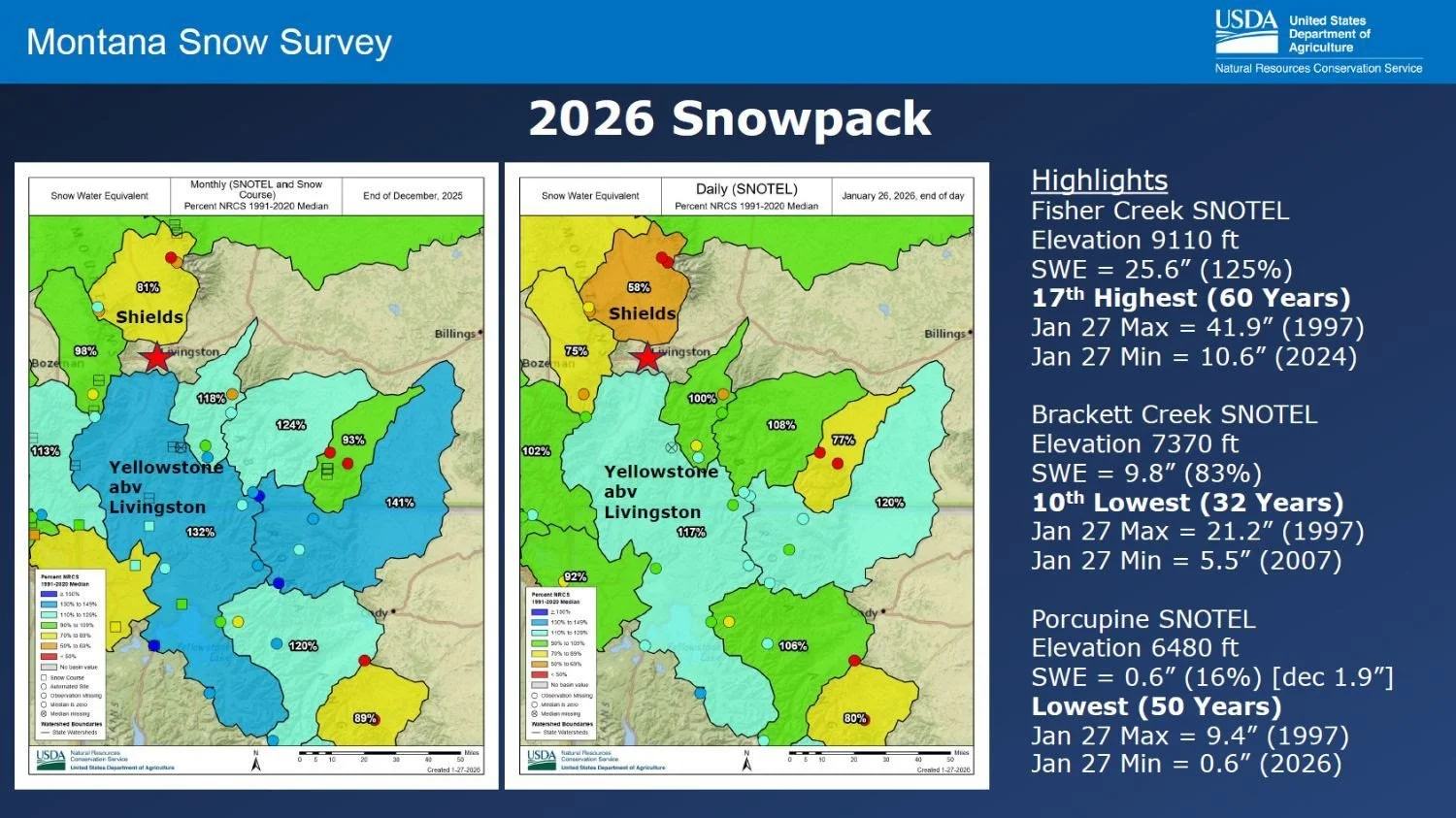
Slide from Larson’s presentation showing the differences in SWE at 9110 ft, 7370 ft, and 6480ft.
While the current winter weather feels abnormal, Dr. Cathy Whitlock explained that what we are experiencing is in line with long-term climate trends and future projections. We are on a warming trend, and Montana has warmed as fast as any state in the country. Our future likely holds warmer winters where the rain/snow line consistently sits at higher elevations, leading to lower snowpack levels for our valleys.
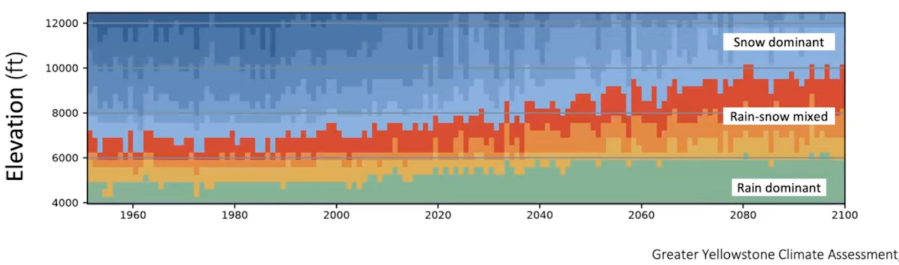
Figure showing increase in snow dominant elevations from 1950-2100
While climate change projections can often feel despondent, it’s important to remember that the path forward is full of opportunity. As Dr. Whitlock put it:
"Climate change is a problem that we can solve, and the solutions actually are cheaper, they’re healthier, they’re local, and they’re cleaner.”
For those feeling worried about the lack of snow in the valley right now, Larson reminded us that we have two to three months left in the snow accumulation season. He emphasized that SWE levels are just one piece of the water supply puzzle, not a standalone predictor of hydrologic outcomes.
Keep doing your snow dances!