Beyond the cloud: Unpacking AI Data Centers in Montana
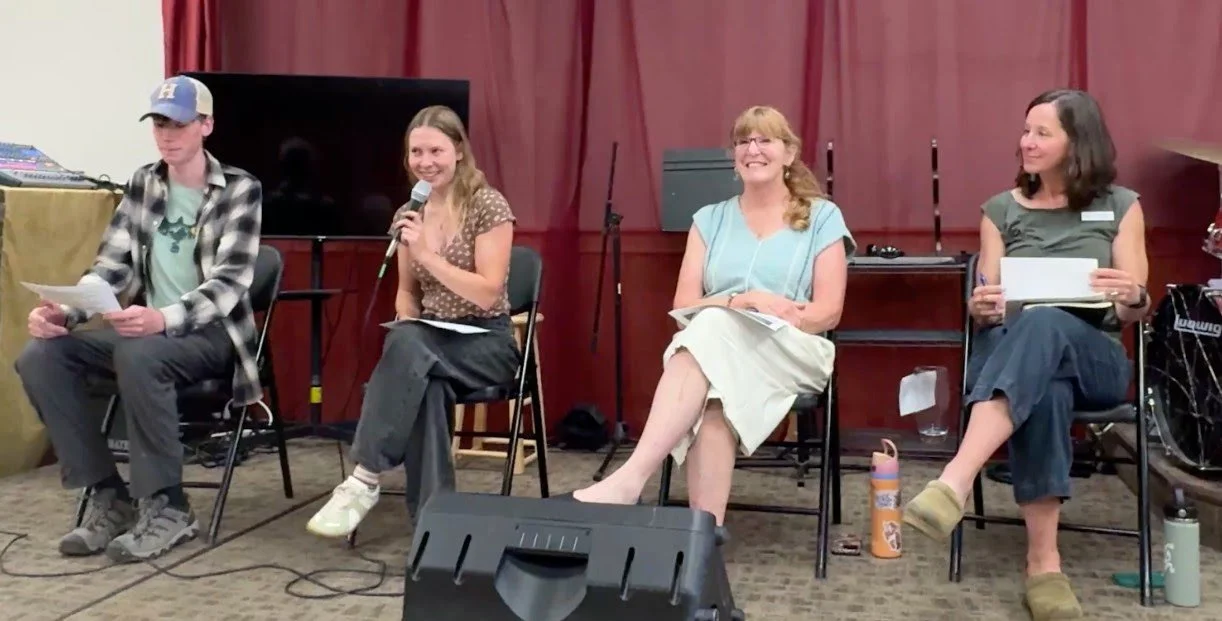
AI Data Center Panelists from left to right: Finn Harrison, Eva Lighthiser, Anne Hedges, and Barbara Chillcott
The story of artificial intelligence is often told as something weightless - floating somewhere in "the cloud." In early August, we gathered with community members and experts to peel back the layers of this digital enigma. It was an evening rooted in shared curiosity and care for this place. Currently, no AI data centers are proposed in Park County, so we didn’t meet because of an immediate crisis. Instead, we came together to learn in public, to understand a fast-moving trend, to ask hard questions, and to untangle how to protect the future of our home.
Together, we explored the unprecedented scale and energy demands of AI data centers, discovering how the advanced processing chips driving large language models require power that completely dwarfs traditional data storage or crypto mining. To put it into perspective, NorthWestern Energy’s entire grid currently averages ~750 megawatts with peak demands reaching to 1,200 megawatts. Across Montana, developers have proposed roughly 12,000 megawatts of power capacity for AI data centers, with a single facility in Broadview accounting for ~9,000 megawatts.
That kind of energy load demands new transmission lines, substations, and grid overhauls. Without strong regulatory safeguards forcing tech corporations to pay their fair share, utility companies typically pass those construction costs on to local families. We have the opportunity to look at the hard lessons from other counties and states to gain foresight and demand ratepayer protections before our energy bills rise.
A recent cautionary story out of Cheyenne, Wyoming shows us the importance of transparency. The city had to refuse wastewater from a Meta data center after cooling additives contaminated their treatment system.
Behind all that processing power, is an immense need for cooling, which often relies heavily on local water supplies. In Park County and across Montana where water availability is limited, heavy year-round demands for cooling systems would present a real conflict with water rights and peak summer droughts. Beyond water usage for cooling, power generation itself also carries a large water footprint. The issue with datacenters and water as a whole is that the impacts are very localized. The question is not only how much water will be used, but where is the water coming from?
From the Q/A session
Question: Explain why AI datacenters are coming into rural areas.
Anne: Because rural areas have no zoning.
So what can we actually do? It starts with talking to your neighbors and sharing your thoughts with our decision-makers. Tell them what matters to you. Here are a few practical safeguards our panelists highlighted that are worth bringing to those conversations:
Require tech companies to disclose what additives are in their wastewater so we know what to monitor and test for.
Establish quiet-zone limits; following Missoula’s 50 - 70 dB property-line standards and similar proposed rules in Bozeman.
Insist that developers cover their own infrastructure costs rather than passing those expenses onto local electricity bills.
Support broader statewide protections, like the consumer resolution passed by the Montana AFL-CIO this summer.
As PCEC intern Finn Harrison thoughtfully articulated:
"It’s a local thing, with achievable results, that you can do something about and you can see the progress on the issue."
That sense of ownership brought a wonderful full-circle moment to the night. The event served as the capstone for our 2026 summer interns, Eva Lighthiser and Finn Harrison, who initiated, hosted, and led the gathering.
Throughout the summer, Eva and Finn were continually learning in their positions at PCEC, diving into community advocacy, meeting local changemakers, and building a richer understanding of the place they call home. Growing up in Livingston and exploring Park County's wild backyard gave them a strong foundation, and their hands-on work with PCEC this summer allowed them to expand their skills, knowledge, and insights into conservation leadership.
Now that they've headed off to college for the school year - Eva returning for her sophomore year at Colorado College and Finn heading to Hamilton College in upstate New York for his freshman year - they left with invaluable real-world experiences that make them even more prepared to learn, grow, and lead.
They leave us with a brighter perspective and leadership skills that will serve them well in higher education and beyond. We wish them all the best on the road ahead!